Recently I was contacted by a friend who had a favor to ask. She was looking for some pictures, primarily a portrait, for a project they were working on. The project was something they were calling "Wedding Cans." They were going to attempt to pay for their modest wedding by recycling cans. This wasn't possible by themselves, obviously. Even a modest wedding can cost several thousand dollars and I don't know of anyone who can consume that many soft drinks. Their plan revolved around the idea that people would gladly donate cans for the cause. In the process, via recycling of an estimated 400,000 aluminum cans they would completely offset the carbon footprint of their wedding. It was a beautiful thing, the idea of environmental activism and financial necessity coming together in a fun way. For the press purposes online and off they were going to need a few portraits.
It was a simple project and one that I was glad to help out with. In the name of serving the purpose of Wedding Cans, I was doing it pro-bono. A quick shoot, 30-45 minutes including conversion, color correction, and sharpening. In and out. No big deal.
The pictures we came out with the first go were not to my liking. I have certain high standards that I put out there, and that night, due to equipment malfunctions and freezing fingers in the sub 20 degree weather we walked away with images that I didn't consider good enough.
I immediately knew that I wanted to re-shoot. While I know many folks would have walked away figuring, "No big deal, free shoot. You get what you pay for," I just couldn't do it. It was leaving unfinished business on the table.
We got together again a short time later, this time at Andrea and Pete's house. We did another quick shoot. All told, I was in 30 minutes once again. But this time, we nailed it. We ended up with shots we were all happy with. I walked away thinking that I had done my part to help out, and didn't expect much more to come of the images.
That's when Andrea's ability to put out a marketing blitz took over.
Immediately the story of the crazy couple, paying for their wedding with aluminum cans was on a few blogs, along with the photos. Thanks to Andrea's knowledge of how things are supposed to work in the media world, the photos included a link to my website. If you're here because of those images, welcome. Have a look around. Let me know if you see anything you like.
It didn't stop there, though. Soon, a local news station picked up the story. They ran a video that included my still images. Andrea and Pete were interviewed by a local morning show.
Then the A.P. picked up that video. Then Fox News.com, the CNN.com, then a dozen financial websites and recycling sites and environmental sites. Then the national morning shows began calling up Andrea and Pete for interviews. Then national radio, and international radio, and more websites, and more news programs, and more websites, and on and on and on.
And a large number of them linked back to my website. My traffic went throught the roof pretty quickly. All from a free shoot that I decided to do over because it wasn't up to my standards.
Admittedly, not every free shoot we do for a friend who has a project that we'd like to support will end up this way. Not every friend working on a project is Andrea. Her ability to generate interest in this has not only been of benefit to their cause (as of writing this, Wedding Cans is up to 76% of goal. That means they've collected over 300,000 cans in a month) but to mine as well. But everyone has friends with projects. If it is something you believe in, or just something you think is cool, do your part. Help out.
And for goodness sake, never let a shoot end with you feeling like you didn't get the shot without rescheduling if at all possible. It's about producing the best work you possibly can in every situation. If equipment fails, that's not an excuse. If it's cold, that's not an excuse. Make it happen. Your "A" game is the only game that's acceptable. It's just that simple.
Besides, you never know where that simple portrait of a friend is going to end up, or who's going to end up seeing it. All it takes is one good impression.
Wedding Cans

Thoughts from commercial, editorial, and people photographer, Tyson Habein.
Wednesday, January 20, 2010


Friday, January 1, 2010
The Flavor of Your Photography
Let's talk about vision. Let's talk about finding your personal photographic vision. Some people seem to come out of the womb with a photographic style. They have a certain pallet that they work from, that suits their shooting, their intent, and their spirit. Those people are few and far between. The rest of us either ignore the idea of a vision or style and content ourselves with the craft of photography and creating images that are generally pleasing to the largest swath of people we can, or we obsess over finding our own individual flavor. There is nothing wrong with the first. I would say, the act of creating generally pleasing photography, vs. photography that is in a very individual style that may not please some is the difference between the craftsman who makes generally pleasing and widely purchased and used chairs, and the one who makes a sculpture masquerading as a chair. One is a true craftsperson, making something of very common origins, with a perfectly standard usage. This is not to disparage that craftsperson, as most craftspeople do things that I couldn't dream of doing. Those at the top of their fields have the skills that most of us would give out left hand for.
That said, the individual who makes the sculpture that happens to be a chair, that individual who makes something that is perhaps more pleasant to look at than to actually sit in, or perhaps something that is only to their personal taste and not to the tastes of most, that person is an artist. That person does not concern themselves with the number of people who appreciate their chair. That person concerns themselves only with whether or not that chair speaks to them personally.
There is a joke somewhere here about photography and chairs both having a lot of butts in them.
The second variety of person, that person who searches endlessly for their style, is the one that interests me the most. I find the search for one's self in one's art interesting. I think most artists who would consider themselves intellectuals in the least do. For most of us, it is at the core of every piece we create. Though I may have a home and a wife, children, a business, friends, social connections, etc., etc., when I take a photograph what I'm really asking is what is this world around me and how do I fit in it? Who am I? What is my nature? There is an entire school of thought that believes the Mona Lisa is actually a self portrait with a different gender. I think, that even if there was a sitter for Davinci, the painting is still of him. An artist puts themselves into every piece they work on.
The question that so many photographers ask is, "How do I develop a style that's my own?" and the standard response from more seasoned shooters, regardless of skill or the visual volume of their own "voice" is, "Don't worry about it, it will come with time." But in a world now populated by cheap lights, cheap digital cameras, pirated software to make your photographs more perfectly fit what you want than reality ever could, and all manner of instant gratification, "it will come with time" is not something most are willing to hear. So we do worry about it. We start forcing it. Often, we mimick the styles and passions of those that we admire. We fall into the roll of expert forger, able to recreate the artwork of masters, without possessing the individual voice to create on our own. We have all the right tools, but the original vision leaves us completely. When unused, our creative vision atrophies.
At the age of 27, I am a child of a world of instant gratification. I would, however, like to think that I am a student of an earlier time. With that in mind, I think that there are things one can do to accelerate a voice's rise to the surface.
1. Limitation: Limiting your options can be a beautiful thing. So ofte, photographers become paralyzed with choice. Do I use the telephoto or go wide angle? Do I light it or go natural? Do I heavily coahc a model or let them run with an idea? Black and white or color? Heavily photoshopped or not at all?
Years ago, this wasn't an issue for a new photographer. You put your one lens on your one body, put in a roll of film and until that roll was gone, that dictated how you shot. You were limited in your options and learned how that affected your reactions. With this in mind, I always recommend that a new photographer and a seasoned pro alike take a day, a week, a month, and shoot with 1 body, 1 lens, on one setting. I'm fond of throwing the camera on heavy contrast black and white and running with it. I don't change settings outside of shutter speed and aperture. I've even gone so far as to use an old manual focus, manual aperture lens with an adapter on my digital body. It slows me down. It affects my decision making. It shows me what matters to my personal vision.
2. Sloooooooooowwwwwwww doooooooooooooowwwwwwwwwnnnnnnnnnn: take your camera out of burst mode, first of all. There is nothing that makes me cringe more than hearing someone fire off 30 shots in 10 seconds of the same thing. Frame the image, look at all four corners of the frame. Change angles and look at how the light comes in differently. Go with a narrower D.O.F. and explore putting pieces out of focus that you wouldn't normally. Toy with the idea of softness and blur.
You'll notice that not once during these directions did I say, "take the picture." Before you take one shot, you should have created 20 images in your head. Try it. Don't spray and pray. Meditate, reevaluate, and create.
3. Break your habits: I love to shoot wide angle. For a long time, it was all wide angle with heavy lighting. lately, I've been pushing myself to shoot with only a standard focal length.
It's not about what you're looking through. It's about how you see. If you can get yourself out of your comfort zone for just a little while, you'll return to it with a a different viewpoint. It's like leaving the country to visit a foreign land. When you come home you see things a little differently than before you left.
4. Find your loves: What is it that you do when you're not shooting? What is it that you would rather do than anything else? (outside of shooting) Where would you like to be right now? Make that, the flavor of your photography.
Recently, i saw a question that was sent to a professional advertising shooter. The individual was responding to the statement that you should shoot what your into. They asked, "I love wine. How can I incorporate this into my shooting?" The photographer came back with the humorous response of "drink while you shoot." While this is funny, it doesn't address the passion portion of the idea. I would respond with a question in return. What do you love about wine? If it's just that you're a raging alcoholic, I can't really help you except to suggest you call your local AA branch. But if it's something else, say the history of the drink, or the variety of wines, the paring with food, the memories of having fun with friends, making new friends and living life, then you have the start of a photo. Hell, with those things you have the start of 1000 photos. And you're the reason you're passionate about wine will show through in them. Your passion becomes your flavor.
Take photos of your friends sitting around playing games, having fun, laughing and enjoying your favorite bottle of wine. Find the beauty in your life, in your subject matter. Make those images speak to you, and they will speak to others. If you position yourself right, they will speak to wineries that need advertising materials. They will speak to food magazines and restaurants that need images. They will speak to magazines that need lifestyle images. And if you're very very good, they will speak to others who love wine the same way you do.
You'll know you're hitting the right notes when you take a step back, as that question again, "who am I and how do I fit into this world?" and the answer can be given by pointing at your photographs. You're flavors there, it just needs a little simmering to come to the surface.
I look forward to using my images to speak of myself, to myself and hopefully to some of you throughout the next year and beyond. I look forward to many of you speaking back.
Happy New Year
Tyson Habein
YellowHouse Photography
SPOKE(a)N(e) Magazine
509-981-9609
That said, the individual who makes the sculpture that happens to be a chair, that individual who makes something that is perhaps more pleasant to look at than to actually sit in, or perhaps something that is only to their personal taste and not to the tastes of most, that person is an artist. That person does not concern themselves with the number of people who appreciate their chair. That person concerns themselves only with whether or not that chair speaks to them personally.
There is a joke somewhere here about photography and chairs both having a lot of butts in them.
The second variety of person, that person who searches endlessly for their style, is the one that interests me the most. I find the search for one's self in one's art interesting. I think most artists who would consider themselves intellectuals in the least do. For most of us, it is at the core of every piece we create. Though I may have a home and a wife, children, a business, friends, social connections, etc., etc., when I take a photograph what I'm really asking is what is this world around me and how do I fit in it? Who am I? What is my nature? There is an entire school of thought that believes the Mona Lisa is actually a self portrait with a different gender. I think, that even if there was a sitter for Davinci, the painting is still of him. An artist puts themselves into every piece they work on.
The question that so many photographers ask is, "How do I develop a style that's my own?" and the standard response from more seasoned shooters, regardless of skill or the visual volume of their own "voice" is, "Don't worry about it, it will come with time." But in a world now populated by cheap lights, cheap digital cameras, pirated software to make your photographs more perfectly fit what you want than reality ever could, and all manner of instant gratification, "it will come with time" is not something most are willing to hear. So we do worry about it. We start forcing it. Often, we mimick the styles and passions of those that we admire. We fall into the roll of expert forger, able to recreate the artwork of masters, without possessing the individual voice to create on our own. We have all the right tools, but the original vision leaves us completely. When unused, our creative vision atrophies.
At the age of 27, I am a child of a world of instant gratification. I would, however, like to think that I am a student of an earlier time. With that in mind, I think that there are things one can do to accelerate a voice's rise to the surface.
1. Limitation: Limiting your options can be a beautiful thing. So ofte, photographers become paralyzed with choice. Do I use the telephoto or go wide angle? Do I light it or go natural? Do I heavily coahc a model or let them run with an idea? Black and white or color? Heavily photoshopped or not at all?
Years ago, this wasn't an issue for a new photographer. You put your one lens on your one body, put in a roll of film and until that roll was gone, that dictated how you shot. You were limited in your options and learned how that affected your reactions. With this in mind, I always recommend that a new photographer and a seasoned pro alike take a day, a week, a month, and shoot with 1 body, 1 lens, on one setting. I'm fond of throwing the camera on heavy contrast black and white and running with it. I don't change settings outside of shutter speed and aperture. I've even gone so far as to use an old manual focus, manual aperture lens with an adapter on my digital body. It slows me down. It affects my decision making. It shows me what matters to my personal vision.
2. Sloooooooooowwwwwwww doooooooooooooowwwwwwwwwnnnnnnnnnn: take your camera out of burst mode, first of all. There is nothing that makes me cringe more than hearing someone fire off 30 shots in 10 seconds of the same thing. Frame the image, look at all four corners of the frame. Change angles and look at how the light comes in differently. Go with a narrower D.O.F. and explore putting pieces out of focus that you wouldn't normally. Toy with the idea of softness and blur.
You'll notice that not once during these directions did I say, "take the picture." Before you take one shot, you should have created 20 images in your head. Try it. Don't spray and pray. Meditate, reevaluate, and create.
3. Break your habits: I love to shoot wide angle. For a long time, it was all wide angle with heavy lighting. lately, I've been pushing myself to shoot with only a standard focal length.
It's not about what you're looking through. It's about how you see. If you can get yourself out of your comfort zone for just a little while, you'll return to it with a a different viewpoint. It's like leaving the country to visit a foreign land. When you come home you see things a little differently than before you left.
4. Find your loves: What is it that you do when you're not shooting? What is it that you would rather do than anything else? (outside of shooting) Where would you like to be right now? Make that, the flavor of your photography.
Recently, i saw a question that was sent to a professional advertising shooter. The individual was responding to the statement that you should shoot what your into. They asked, "I love wine. How can I incorporate this into my shooting?" The photographer came back with the humorous response of "drink while you shoot." While this is funny, it doesn't address the passion portion of the idea. I would respond with a question in return. What do you love about wine? If it's just that you're a raging alcoholic, I can't really help you except to suggest you call your local AA branch. But if it's something else, say the history of the drink, or the variety of wines, the paring with food, the memories of having fun with friends, making new friends and living life, then you have the start of a photo. Hell, with those things you have the start of 1000 photos. And you're the reason you're passionate about wine will show through in them. Your passion becomes your flavor.
Take photos of your friends sitting around playing games, having fun, laughing and enjoying your favorite bottle of wine. Find the beauty in your life, in your subject matter. Make those images speak to you, and they will speak to others. If you position yourself right, they will speak to wineries that need advertising materials. They will speak to food magazines and restaurants that need images. They will speak to magazines that need lifestyle images. And if you're very very good, they will speak to others who love wine the same way you do.
You'll know you're hitting the right notes when you take a step back, as that question again, "who am I and how do I fit into this world?" and the answer can be given by pointing at your photographs. You're flavors there, it just needs a little simmering to come to the surface.
I look forward to using my images to speak of myself, to myself and hopefully to some of you throughout the next year and beyond. I look forward to many of you speaking back.
Happy New Year
Tyson Habein
YellowHouse Photography
SPOKE(a)N(e) Magazine
509-981-9609
Tuesday, December 29, 2009
Shooting on the Street

Recently I witnessed a discussion about what sort of shooting on the street was, and what wasn't "street photography". I think that as photographers, we spend far too much time trying to classify and categorize what we do and not nearly enough time doing it.
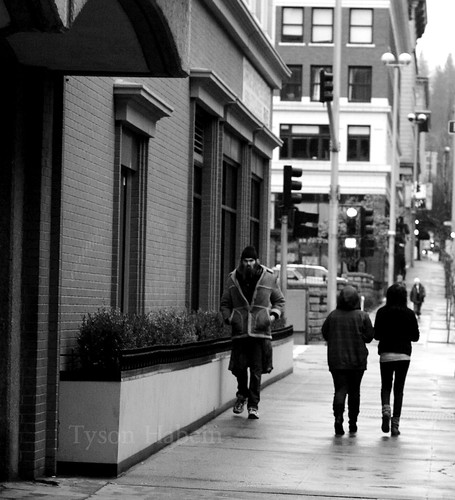
Recently Michael McMullin of Blankline Studios and I went out to do some shooting.
It was the last weekend before Christmas and thus was a busy shopping time for the Spokane downtown core. The only time there was a slow in the foot traffic that is often missing from Spokane is when the rain came. I'm not sure why Sokanites sometimes act as if they're soluble. I promise, the rain won't hurt you. It wasn't enough enough to bother my non-weather sealed camera.
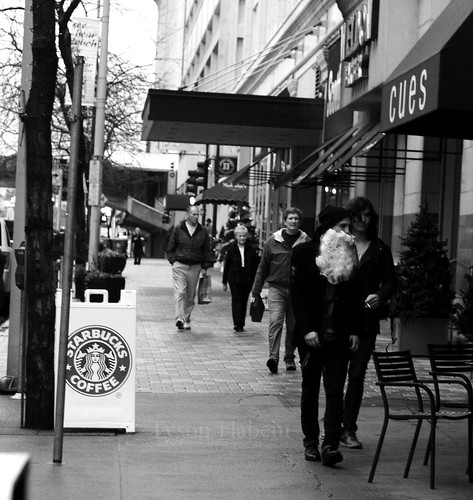

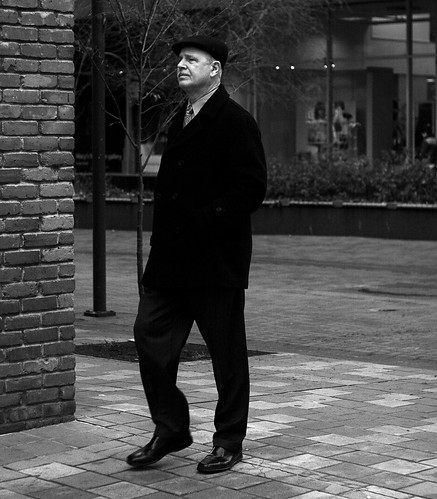
I try to do this sort of thing every so often. It helps me to see things that I normally wouldn't see. It helps me to look at things differently. When one of the images is something that I'm truly pleased with, I can take that perspective and see how it can translate into my other work.
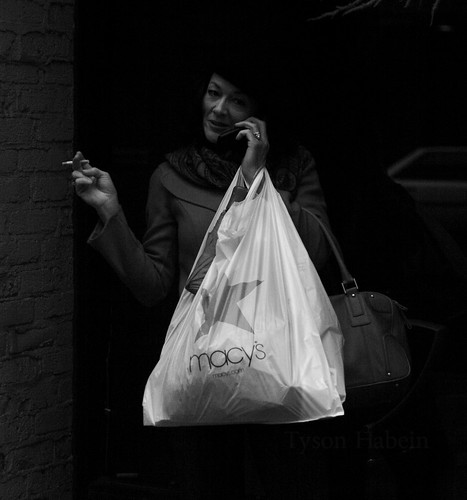
This is personal work, but it's all personal work if you put enough of yourself into it.
YellowHouse Photography main page
Sunday, December 13, 2009
Thought Collective:
These are recent quotes and links and items from around the internet. Things I've found interesting enough to note as of late.
1. From Twitter: @warrenellis note to self: Colour = SUPERFASTSPEED / black and white = STATELY PROCESSION
I passed this along with photographers in mind, while Warren Ellis was speaking in terms of comic books. I find that my thinking in going into an image is much the same. Black and white is the intellectual, the classy, the classic. Color (or colour dependent upon your c.o.o.) is a sports car flying past you at 150 mph. It blows you away in an entirely different way. I love both types of images, and what I want to shoot will shift with my mood. They just work differently.
2. http://www.aphotoeditor.com/2009/12/08/what%e2%80%99s-the-biggest-stereotype-about-photography/
I've made arguments to this nature in the past. I've rambled on and on about how it is because of this that all imagery is subject to interpretation when created and when consumed. It's why so much photography is failing to re-gain the trust it once held. We spend too much time trying to pretend that we had the market on truth cornered to begin with.
3. Twitter again: @ScottBourne When I make a photo that causes someone to think, smile, laugh or cry, what camera, lens, f-stop is of no importance to them.
4. Sounds in Photographs
It makes you wonder what everyone's images sound like.
5. There's Something Big Beyond the Edge of the Universe
If you are a science nerd at all, you must read this. The title should get everyone's attention anyway.
6. Sidewalk Barrier as Expensive Art
It's interesting to think that we may be walking by pieces of art every day, indeed even using them for their utilitarian purposes and never realizing that they're there.
1. From Twitter: @warrenellis note to self: Colour = SUPERFASTSPEED / black and white = STATELY PROCESSION
I passed this along with photographers in mind, while Warren Ellis was speaking in terms of comic books. I find that my thinking in going into an image is much the same. Black and white is the intellectual, the classy, the classic. Color (or colour dependent upon your c.o.o.) is a sports car flying past you at 150 mph. It blows you away in an entirely different way. I love both types of images, and what I want to shoot will shift with my mood. They just work differently.
2. http://www.aphotoeditor.com/2009/12/08/what%e2%80%99s-the-biggest-stereotype-about-photography/
I've made arguments to this nature in the past. I've rambled on and on about how it is because of this that all imagery is subject to interpretation when created and when consumed. It's why so much photography is failing to re-gain the trust it once held. We spend too much time trying to pretend that we had the market on truth cornered to begin with.
3. Twitter again: @ScottBourne When I make a photo that causes someone to think, smile, laugh or cry, what camera, lens, f-stop is of no importance to them.
4. Sounds in Photographs
It makes you wonder what everyone's images sound like.
5. There's Something Big Beyond the Edge of the Universe
If you are a science nerd at all, you must read this. The title should get everyone's attention anyway.
6. Sidewalk Barrier as Expensive Art
It's interesting to think that we may be walking by pieces of art every day, indeed even using them for their utilitarian purposes and never realizing that they're there.
Saturday, December 5, 2009
Advertising is Us
Awhile back I was talking to someone I know who is in their first year of college. She was lamenting the fact that she wasn't enjoying the journalism program at her school and didn't know what else to go into. I asked her what sort of classes she was taking that she did enjoy.
She said she was enjoying her art classes and some design-type classes that she was taking at the moment. Immediately, she followed this statement with a qualifier: "I don't want to do advertising, though."
This piqued my curiosity. As someone who intends to work in the realm of advertising photography, I wanted to know why she would be so adverse to the field as a potential career.
"Advertising is just so evil. I mean, the way they target people."
This brings up an interesting idea that has become more prevalent in the last 15-20 years: "Advertising is evil."
While I think blanket statements such as this almost always have poor reasoning behind them, the idea of 'advertising as evil' is something that has become fairly standard amongst a younger generation of consumers. I certainly do have my issues with the operating standards of many advertisers (corporations, and the companies that produce their ads, can at times be flawed, as they are run by people), but I think I am in the minority of a younger population in that I don't find advertising abhorrent.
The idea that targeted advertising is evidence of evil is an odd one to me. As a business, the name of the game is minimizing costs while maximizing income. This is the line that separates the profitable from the failing. Furthermore, targeted advertising is something that allows the consumer to sort through the much of the daily commercial world.
When I get up in the morning, I see advertisements in between segments on morning TV. As I leave the house, I hear advertisements on the radio in my car. As I drive, I see advertisements on billboards, the sides of buildings, and other vehicles. When on the computer, almost every webpage has advertisements of some sort. With advertising everywhere, isn't it useful for a consumer to know that, at least a small portion, of those ads are specifically chosen for them? Imagine a world in which all of the advertisements you saw were aimed at you. There would be fewer ads, to be sure, because the ads that were present would be far more effective. Advertising would be less scattershot and more pinpoint. This relieves me, as the consumer, of the overload that is so often complained about. This relieves me, as the business owner, of the massive cost of 20 ads. I can put out just 1.
The idea of evil in this likely stems from the ability to target. In order to generate a targeted ad, the advertiser has to have information about you. They have to have access to your Facebook profile and all the information therein. They have to know you are a 20 something who likes video games and beef jerky (but then, who doesn't?). This seems to still invade the sense of privacy that many people have held on to.
Privacy, or perhaps the desire for it, is what makes advertising evil. But in our modern world we've all but tossed privacy out the window. Your average teenager has a Myspace account, a Facebook account, a Twitter account, a traceable cell phone, a Google search history, an Amazon buying history, etc. etc. etc. For a new generation of consumers, the idea of privacy is, at best, an illusion.
But the fact that the perceived evil of advertising may be an antiquated notion is irrelevant. If there is one thing that a lifetime of looking at advertising has taught me, it is that perception is everything. Perception is truth. And if advertising that tries to sell you something is perceived as evil, then it is, at least in the eyes of the consumers you are attempting to reach.
The answer then, is to become smarter in how we advertise. A targeted sales pitch is no longer an option. Instead, we have to ingrain a brand in the day to day lives of our targeted consumers. We don't show the product and simply tell you how much it is and where you can get it. We show you the product in the hands of someone you admire who is having an amazing time, and oh, by the way... they just happen to be using this product.
It's not a hard sell that works anymore, it's not a soft sell that works, it's a non-sell. It's a sale by proxy. We buy products because they are a perceived part of the lifestyle we want to lead.
Perhaps as photographers, we can all learn something more from advertising than current trends and lighting styles. Perhaps we can all learn something from those photographers who aren't advertising in the same way anymore -- those photographers whose second job has become promoting themselves as a part of a larger community. Certainly, there is a magnanimous desire to help the community involved in this for most of these individuals. But no one can deny that people like David Hobby and Chase Jarvis have benefited greatly from their role in the photographic community.
The reason is this: when an art director looks to what is going on in the world, they are swayed by those who have great pull amongst a large group of people. If 10,000 people fawn over the work of Chase Jarvis, it must have some resonance with consumers.
At a certain point, to anyone who is interested in the field, Chase Jarvis becomes a household name. It's like a celebrity endorsement, except the photographer becomes their own celebrity.
As photographers who want to work in advertising, we have to understand advertising. We have to become advertising. In a modern era of peer networking, targeted advertising, and group thinking, advertising isn't evil. Advertising is us.
She said she was enjoying her art classes and some design-type classes that she was taking at the moment. Immediately, she followed this statement with a qualifier: "I don't want to do advertising, though."
This piqued my curiosity. As someone who intends to work in the realm of advertising photography, I wanted to know why she would be so adverse to the field as a potential career.
"Advertising is just so evil. I mean, the way they target people."
This brings up an interesting idea that has become more prevalent in the last 15-20 years: "Advertising is evil."
While I think blanket statements such as this almost always have poor reasoning behind them, the idea of 'advertising as evil' is something that has become fairly standard amongst a younger generation of consumers. I certainly do have my issues with the operating standards of many advertisers (corporations, and the companies that produce their ads, can at times be flawed, as they are run by people), but I think I am in the minority of a younger population in that I don't find advertising abhorrent.
The idea that targeted advertising is evidence of evil is an odd one to me. As a business, the name of the game is minimizing costs while maximizing income. This is the line that separates the profitable from the failing. Furthermore, targeted advertising is something that allows the consumer to sort through the much of the daily commercial world.
When I get up in the morning, I see advertisements in between segments on morning TV. As I leave the house, I hear advertisements on the radio in my car. As I drive, I see advertisements on billboards, the sides of buildings, and other vehicles. When on the computer, almost every webpage has advertisements of some sort. With advertising everywhere, isn't it useful for a consumer to know that, at least a small portion, of those ads are specifically chosen for them? Imagine a world in which all of the advertisements you saw were aimed at you. There would be fewer ads, to be sure, because the ads that were present would be far more effective. Advertising would be less scattershot and more pinpoint. This relieves me, as the consumer, of the overload that is so often complained about. This relieves me, as the business owner, of the massive cost of 20 ads. I can put out just 1.
The idea of evil in this likely stems from the ability to target. In order to generate a targeted ad, the advertiser has to have information about you. They have to have access to your Facebook profile and all the information therein. They have to know you are a 20 something who likes video games and beef jerky (but then, who doesn't?). This seems to still invade the sense of privacy that many people have held on to.
Privacy, or perhaps the desire for it, is what makes advertising evil. But in our modern world we've all but tossed privacy out the window. Your average teenager has a Myspace account, a Facebook account, a Twitter account, a traceable cell phone, a Google search history, an Amazon buying history, etc. etc. etc. For a new generation of consumers, the idea of privacy is, at best, an illusion.
But the fact that the perceived evil of advertising may be an antiquated notion is irrelevant. If there is one thing that a lifetime of looking at advertising has taught me, it is that perception is everything. Perception is truth. And if advertising that tries to sell you something is perceived as evil, then it is, at least in the eyes of the consumers you are attempting to reach.
The answer then, is to become smarter in how we advertise. A targeted sales pitch is no longer an option. Instead, we have to ingrain a brand in the day to day lives of our targeted consumers. We don't show the product and simply tell you how much it is and where you can get it. We show you the product in the hands of someone you admire who is having an amazing time, and oh, by the way... they just happen to be using this product.
It's not a hard sell that works anymore, it's not a soft sell that works, it's a non-sell. It's a sale by proxy. We buy products because they are a perceived part of the lifestyle we want to lead.
Perhaps as photographers, we can all learn something more from advertising than current trends and lighting styles. Perhaps we can all learn something from those photographers who aren't advertising in the same way anymore -- those photographers whose second job has become promoting themselves as a part of a larger community. Certainly, there is a magnanimous desire to help the community involved in this for most of these individuals. But no one can deny that people like David Hobby and Chase Jarvis have benefited greatly from their role in the photographic community.
The reason is this: when an art director looks to what is going on in the world, they are swayed by those who have great pull amongst a large group of people. If 10,000 people fawn over the work of Chase Jarvis, it must have some resonance with consumers.
At a certain point, to anyone who is interested in the field, Chase Jarvis becomes a household name. It's like a celebrity endorsement, except the photographer becomes their own celebrity.
As photographers who want to work in advertising, we have to understand advertising. We have to become advertising. In a modern era of peer networking, targeted advertising, and group thinking, advertising isn't evil. Advertising is us.
Monday, November 30, 2009
A Trip to Great Falls, MT in photos and commentary
My family, by-in-large is from Montana. My wife is from Great Falls, MT specifically. Usually a few times a year we make the drive to Great Falls to visit. This Thanksgiving, we did just that.
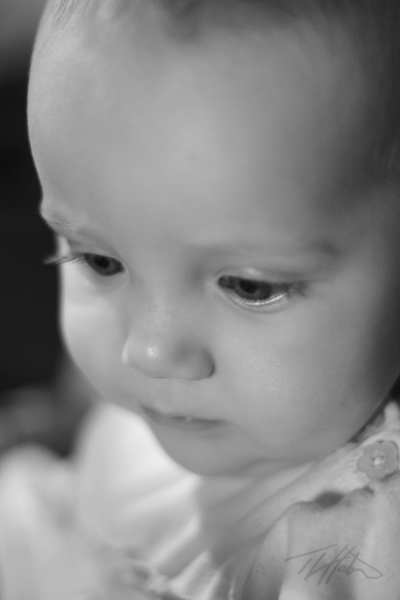
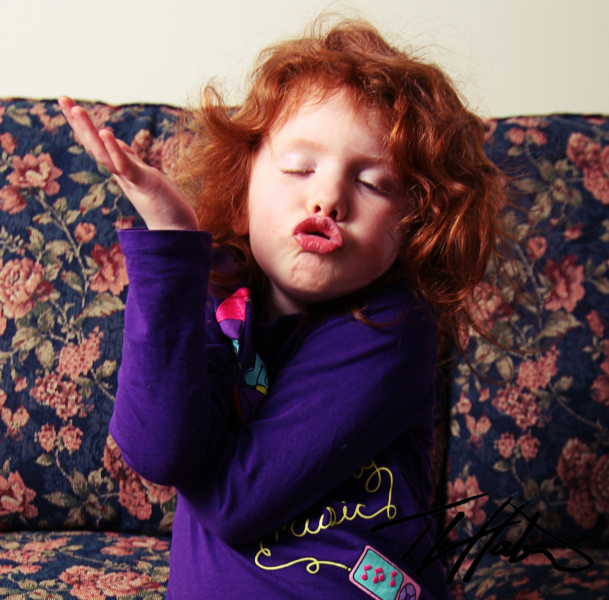
I had a few things that I wanted to do while we were in Great Falls, besides the obvious of eating far too much stuffing and pie. I wanted to get a few nice shots of the kids, including our niece Shiloh, and I wanted to visit some of the Great Falls art galleries.
Shiloh:
Grace:
Trips to art galleries are a regular happening while at home, (see: SPOKE(a)N(e) Magazine: ) but we had neglected it every time we've been back to Great Falls.
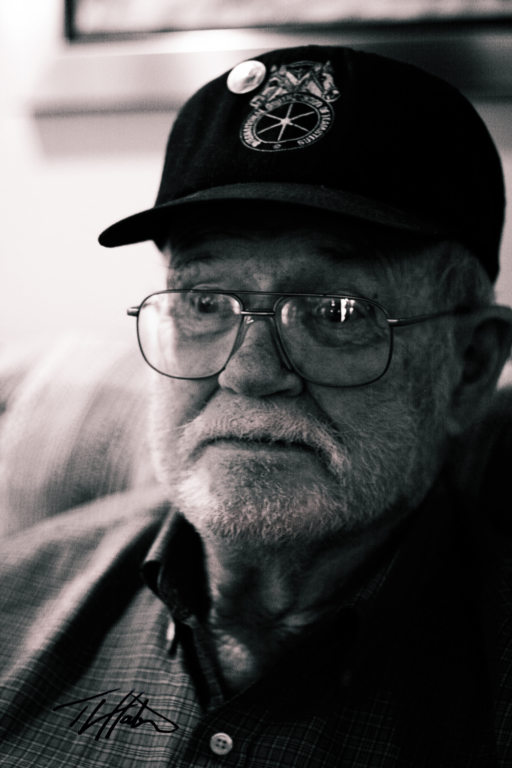
At A Hooker's Gallery, an older gentleman was sitting in the coffee shop area. He was listening to the football game playing on the radio. I asked if I could take his picture and he agreed, not changing a bit as I snapped a couple of frames.
While we visited several galleries that were pleasing, most using the multiple artists at all times format, the location that stood out the most to me was the Paris Gibson Square Museum of Art. Not only was there a large assortment of really nice pieces and bits of work in multiple rooms, the building itself was a work of art.
I was told by my mother-in-law that the building was blown up in the 60s for a movie and then re-built. I'm sure CGI is much cheaper, but you've got to admire that level of dedication.
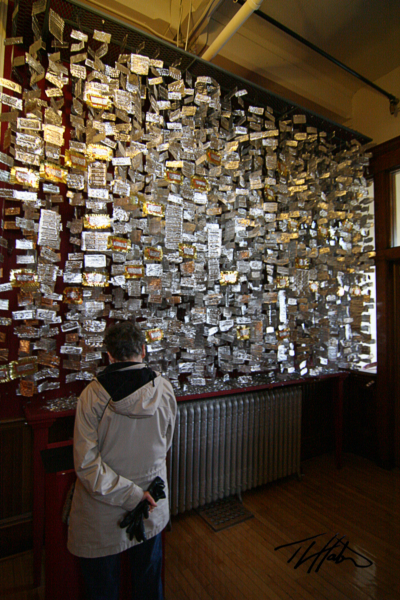
Specifically in the Paris Gibson Square, Harold Schlotzhauer had some wonderful pieces in a show titled "Objects in Motion". He has a great sense of modern graphic design with digital prints on a variety of materials, from plastic sheeting, to skateboards. Also at Paris Gibson, was the piece "Three-Thousand and Counting" which includes dog-tags for every American soldier killed thus far in the Iraq war. A moving and beautiful piece.
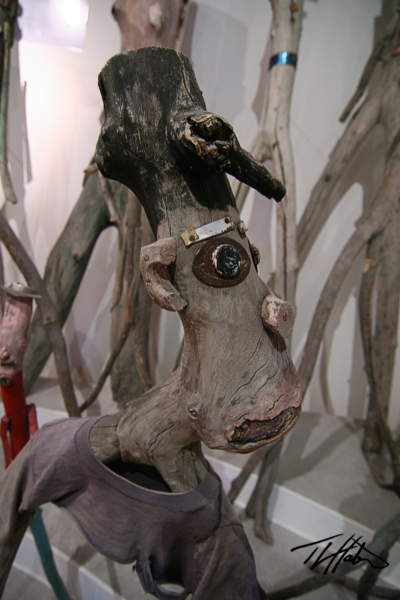
There was a room full of tree branch statues. Ranging from cowboy's to unknown creatures, these pieces had a bit of the creepy, and a bit of the humorous. Worth seeing based on the skill of the artist to find a "face" in a piece of wood, alone.
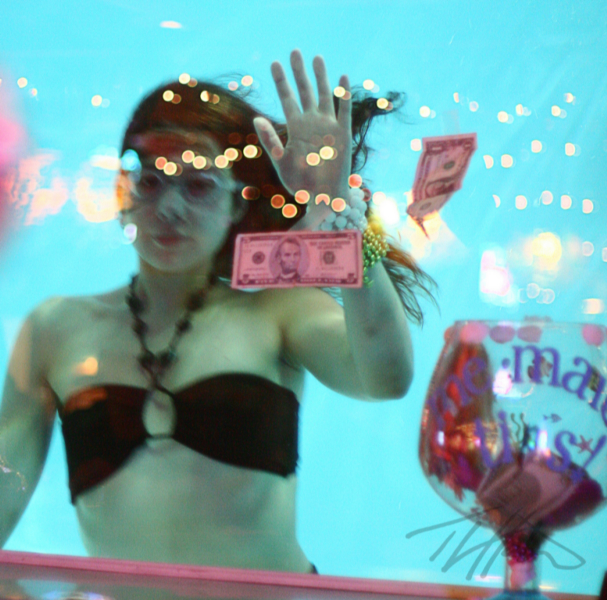
The last night we were in town we did the classic Great Falls thing, and went to a bar called The Sip n' Dip. At the Sip n' Dip, besides having Piano Pat (an older woman playing such classics as "brown eyed girl" at an electric organ) there are mermaids behind the bar. Most evenings, as you enjoy your beverage of choice, a mermaid swims in the hotel pool visible behind the bar. Patrons leave tips in a jar and taped to the window for the mermaids. It's an experience I haven't ever heard of anywhere else.
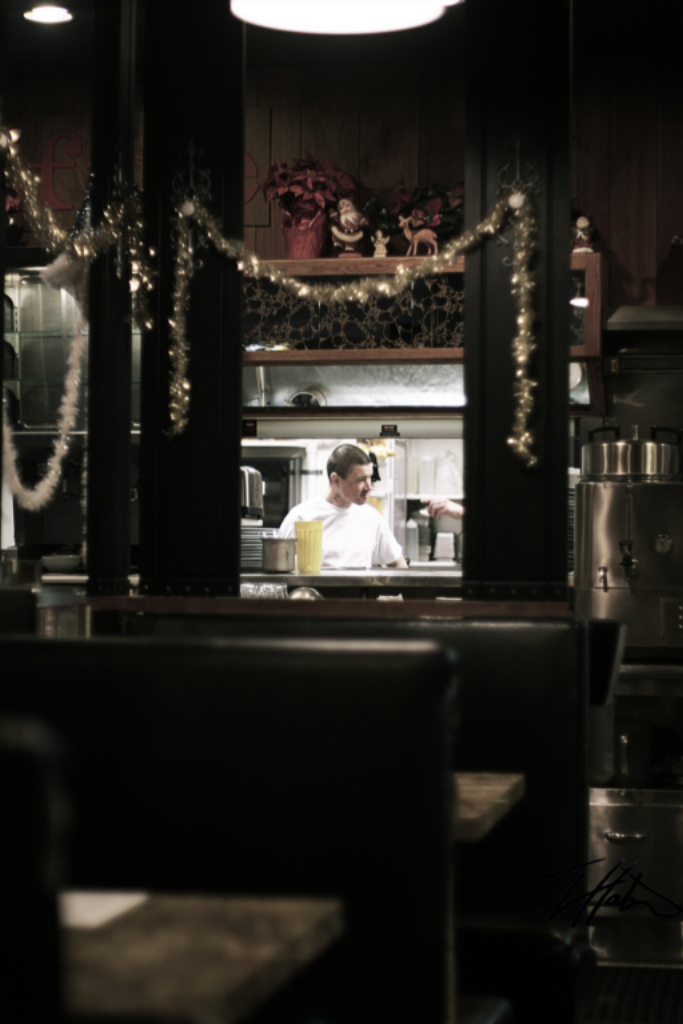
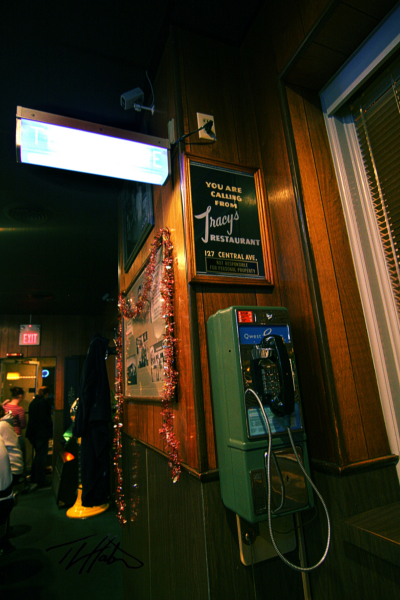
After the Sip n' Dip, diner food is almost always a necessity. As such, Tracy's is the place to go. Tracy's is a diner seemingly unchanged since the 1950s. Mini-jukeboxes at each table, coffee as black as night, and a white shirted cook behind the counter, Tracy's begs for a photoshoot to go down there. I'm told, more than 1 movie in town has used the location.
Overall, it was a good trip, and I'm going to be sure to hit up the art galleries every time I'm back in town from now on.
I had a few things that I wanted to do while we were in Great Falls, besides the obvious of eating far too much stuffing and pie. I wanted to get a few nice shots of the kids, including our niece Shiloh, and I wanted to visit some of the Great Falls art galleries.
Shiloh:
Grace:
Trips to art galleries are a regular happening while at home, (see: SPOKE(a)N(e) Magazine: ) but we had neglected it every time we've been back to Great Falls.
At A Hooker's Gallery, an older gentleman was sitting in the coffee shop area. He was listening to the football game playing on the radio. I asked if I could take his picture and he agreed, not changing a bit as I snapped a couple of frames.
While we visited several galleries that were pleasing, most using the multiple artists at all times format, the location that stood out the most to me was the Paris Gibson Square Museum of Art. Not only was there a large assortment of really nice pieces and bits of work in multiple rooms, the building itself was a work of art.
I was told by my mother-in-law that the building was blown up in the 60s for a movie and then re-built. I'm sure CGI is much cheaper, but you've got to admire that level of dedication.
Specifically in the Paris Gibson Square, Harold Schlotzhauer had some wonderful pieces in a show titled "Objects in Motion". He has a great sense of modern graphic design with digital prints on a variety of materials, from plastic sheeting, to skateboards. Also at Paris Gibson, was the piece "Three-Thousand and Counting" which includes dog-tags for every American soldier killed thus far in the Iraq war. A moving and beautiful piece.
There was a room full of tree branch statues. Ranging from cowboy's to unknown creatures, these pieces had a bit of the creepy, and a bit of the humorous. Worth seeing based on the skill of the artist to find a "face" in a piece of wood, alone.
The last night we were in town we did the classic Great Falls thing, and went to a bar called The Sip n' Dip. At the Sip n' Dip, besides having Piano Pat (an older woman playing such classics as "brown eyed girl" at an electric organ) there are mermaids behind the bar. Most evenings, as you enjoy your beverage of choice, a mermaid swims in the hotel pool visible behind the bar. Patrons leave tips in a jar and taped to the window for the mermaids. It's an experience I haven't ever heard of anywhere else.
After the Sip n' Dip, diner food is almost always a necessity. As such, Tracy's is the place to go. Tracy's is a diner seemingly unchanged since the 1950s. Mini-jukeboxes at each table, coffee as black as night, and a white shirted cook behind the counter, Tracy's begs for a photoshoot to go down there. I'm told, more than 1 movie in town has used the location.
Overall, it was a good trip, and I'm going to be sure to hit up the art galleries every time I'm back in town from now on.
Subscribe to:
Posts (Atom)